

1. INTRODUCTION
As climate change response and carbon neutrality have emerged as common global challenges, the value of utilizing wood, a sustainable and eco-friendly resource, is regaining attention. Wood absorbs carbon dioxide and releases oxygen in the atmosphere during its growth process while storing carbon. It has also been recognized as an environmentally friendly and sustainable material with lower energy consumption and greenhouse gas emissions compared to other materials during production and processing phases (Robertson et al., 2022; Zadeh et al., 2024). In addition to such environmental contributions, wood has been known as a material with human-friendly characteristics, inducing aesthetic appeal, a warm tactile sensation (Ikei et al., 2017), and emotional stability (Nyrud and Bringslimark, 2010). Accordingly, it has been more widely used in all aspects of daily life, such as education, welfare, and culture, beyond industrial applications.
Many countries recognize wood as a cultural medium for a higher quality of life, developing and operating diverse educational and experience programs based on this awareness. For instance, Japan has institutionalized the concept of ‘wood education (Mokuiku) (??)’ by expanding wood culture experiences into the educational sphere. In 2021, this concept was incorporated into the Forest and Forestry Basic Plan, and has been implemented as a national policy (Forestry Agency, 2021). The wood education-related activities are defined as “activities where all people, including children, interact with wood, learn from wood, and co-live with wood” (Sasaki, 2022). The activities include woodworking workshops, toy making, training in wood education (Mokuiku) Master, and events co-hosted with local governments. In Finland, woodworking activities are also included within the regular curriculum under the Basic Education Act, by incorporating the activities into the handicrafts subject for elementary and secondary education (Interreg Europe, 2020). Kokko and Räisänen (2019) emphasized that Finland’s handicrafts education integrates the concept of environmental sustainability, as well as its educational function of transmitting traditional culture.
Meanwhile, in South Korea, under Article 2-6 of the “Act on the Sustainable Use of Timbers,” timber/wood culture is defined as ‘values, knowledge, norms, and lifestyles which are common to the members of society who favor and use timber/wood products that realize diverse functions of timber/wood.’ Wood education is defined as ‘education whose purposes are to educate the public to understand the importance and obtain knowledge of timber/wood and to have a sound hierarchy of values by systematically experiencing and learning diverse functions of timber/wood’ (Korea Forest Service, 2024). As such, although wood culture and wood education are legally differentiated, wood education, including experience programs, is presented as a core means for spreading wood culture.
To this end, the Korea Forest Service has expanded its policy support to include more diverse initiatives, while creating wood culture experience facilities. The 2024 Wood Culture Index Measurement Project Report (Korea Association of Wood Culture, 2024) revealed that as of December 2023, there were the following wood-related experience and educational facilities in operation: 49 wood culture experience centers, 3016 woodworking experience institutions, 197 recreational forests, 73 arboretums, 13 forest museums, and 26 botanic gardens.
Furthermore, the ‘Wood Culture Index,’ which evaluates the degree of settlement and promotion of wood culture across 17 metropolitan cities and provinces, is annually calculated, recording an average score of 62.9 points in 2024. However, since it has shown stagnation at a similar level over the past five years, there should be more effective policy supplementation. Most of all, empirical data should be prepared by surveying and analyzing public awareness and the current status of wood culture and experience programs.
In previous studies, Han and Lee (2021a, 2021b), Han et al. (2022) analyzed public attitudes and awareness regarding perceptions of wood culture, resource status, and utilization trends in residential environments, resource status, and utilization trends in residential environments, thereby establishing a conceptual foundation and diagnosing the awareness level per resource type. This study aimed to explore improvement strategies for experience programs from an educational perspective, thereby contributing to the dissemination of wood culture. Specifically, this study empirically examined the public’s preferred wood products and their intention to participate in production. By analyzing how these demands can be connected to the real-world experience programs, it intended to provide foundational data for future policy and program design.
2. MATERIALS and METHODS
A survey on 2,500 adults aged 19 years or older in South Korea was performed online via a web panel from October 20 to October 29, 2020 (Han et al., 2022). The respondents were proportionally allocated according to the population composition ratio by gender and age in 17 metropolitan cities and provinces in South Korea. Table 1 presents the general characteristics of the respondents by gender, age, education level, household income levels, age of youngest child, region, and area classification.
This study constructed survey questions with the following items to identify perceptions, preferences, experiences, and future demand for wood culture: preferred products using wood, changes in perception and effects based on wood culture experiences, intent to participate by type of wood culture, preferred operation methods in wood culture experience programs, appropriate program operation time, intent to pay for wood culture experience programs, desired program types for participation with children and reasons, as well as measures to revitalize wood culture experience (Table 2).
3. RESULTS and DISCUSSION
Responses to the subjective question about wood products respondents wanted to create themselves were collected and presented as a word cloud based on response ratios in Fig. 1. The general public expressed their desire to create wood products in the following order: ‘furniture’ (13.9%), ‘chair’ (11.4%), ‘table’ (8.4%), ‘desk’ (8.0%), ‘wooden houses/Hanok (traditional Korean-style house)’ (6.7%). Except for those who responded they had nothing they wanted to make (2.6%), the wood products they wanted to create can be classified into three types: furniture (68.1%), accessories (22.3%), and wooden houses (7.0%).
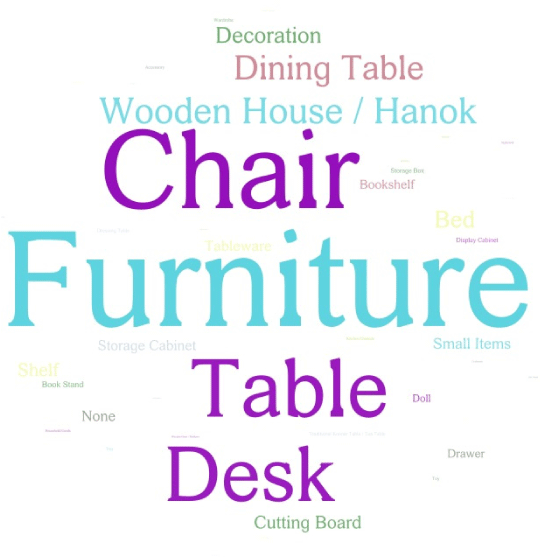
These response rates are similar to the free-response rates for desired creations in wood culture experience programs: furniture (80.7%), accessories (12.1%), and structures (5.2%). The response types also exhibited little difference from those suggested in free-association images for ‘wood’ or ‘wood culture’ (Han and Lee, 2021a). The responses to the subjective question on desired wood-made gifts can also be classified into the following desired creations: furniture (60.0%), accessories (37.2%), and structures (2.8%; Fig. 2). In particular, the most desired wooden gifts among the general public were ‘chair’ (11.8%), ‘furniture’ (9.1%), ‘table’(8.3%), ‘accessories’(5.9%), and ‘ornaments’ (5.8%).

The results indicate that the majority of respondents prioritized furniture and accessories in woodworking experience programs. This outcome shows a high demand for creating practical products that can be used continuously in daily life, beyond simply consuming wood as a raw material. It also reveals that respondents recognized the practicality and aesthetic appeal of wood products as important factors, and in reality, numerous wood culture experience centers provide programs closely aligned with these preferences. This trend is also in a similar context to the finding of a study conducted by Harju and Lähtinen (2021) in Finland. They reported that the quality perceptions of indoor wood products were associated with four factors such as harmony with lifestyle, visual and tactile appeal, environmental friendliness, and technical robustness.
This study additionally surveyed experience effects to analyze how the survey results on preferred products and production intentions could be associated with real-world program operations. As a result of examining the twelve items suggested in Table 3 on a five-point scale, these two items showed the highest average values: ‘knowledge and information about forests and trees can be obtained (3.98 points)’ and ‘creativity is improved (3.92 points).’ These results imply that wood culture experiences are not mere crafting activities, but provide educational and cognitive value. Therefore, in relation to the aforementioned preferred product results, respondents’ preference for furniture and accessory making can be interpreted as expectations of educational and emotional effects (e.g., knowledge acquisition, higher creativity, and emotional stability) during the production process, rather than as a preference for the final products themselves. Other previous studies have reported the emotional and educational effects of wood culture activities. Lee et al. (2022) targeted 61 elderly persons with mild cognitive impairment or mild dementia, and ran a wood culture experience program for them, confirming significant improvements in life satisfaction, self-efficacy, resilience, and social support.
As a result of additionally examining the differences from the demographic characteristics, females scored higher than males on most items except for the item of ‘physical functions are improved.’ The respondents, who are older and have children, also tended to have a higher awareness of the effects of wood culture experiences. This result implies that wood culture experiences can serve a significant role in intergenerational exchange and stronger family relationships, beyond a simple individual hobby.
In conclusion, the experience programs should be designed to enhance creativity, a sense of accomplishment, and emotional stability from an educational perspective, rather than being simple activities, to spread wood culture. Specifically, development of problem-solving programs to boost creativity, setting of step-by-step difficulty levels to foster a sense of accomplishment, and expansion of tactile activities with natural materials to strengthen emotional stability are required.
Wood culture experiences were categorized into seven areas, as shown in Table 4: ‘Experience of Wood Culture Heritage’, ‘Wooden architecture experience’, ‘Wooden play experience’, ‘Wood culture events’, ‘Wood education’, ‘Wood culture content’, ‘Wood products.’ The general public’s participation intention for each area was surveyed using a 5-point scale average score. The categorization of each area was previously described in the previous research (Han and Lee, 2021b).
The intention to participate in ‘wood products’ (3.85 points), which includes the creation of wooden furniture and accessories, and ‘wood culture events’ (3.81 points), was found to be the highest (Table 4). This result indicates that the dissemination of wood culture is not limited to simple exhibitions or education, showing that the participants preferred programs where they can create and experience in person. The positive effects of such hands-on experience programs were already confirmed in previous studies. Lee et al. (2022) conducted a systematic literature review on domestic and international woodworking programs, and reported that the programs exerted positive impacts: numerical and scientific cognition, spatial perception, language ability, social skills, physical development, and creativity development in young children; problem-solving skills, self-efficacy, social skills, and emotional development in adolescents; and increased social contact, a sense of accomplishment, pride, and self-identity development in adults, the elderly, and people with disabilities. These findings can also be found in Japan’s ‘wood education (Mokuiku) (??)’ policy, which contributes to the long-term settlement of wood culture through an experience-oriented educational approach. Therefore, South Korea also needs to regularly operate various events linked to hands-on creation experiences and develop region-specific programs.
Meanwhile, in other areas, participation intentions of the respondents were expressed in the following order: ‘experience of wood culture heritage’, ‘wooden architecture experience’, ‘wooden play experience’, ‘wood education’, and ‘wood culture content.’ Among them, the positive response rates for ‘wooden play experience’, ‘wood education’, and ‘wood culture content’ were relatively low (less than 50%). ‘Wooden play experience’ included wooden playgrounds or wooden toys, but since the survey targets were limited to adults, the interest was interpreted to be relatively low. Additionally, the intent to participate in ‘wood education’ was found to be low because the acquisition of related certifications or substantial benefits was not sufficiently promoted. The intent to participate in ‘wood culture content’ was found to be low due to fewer examples of wood-related broadcasts, films, or games domestically compared to other areas.
As for respondents’ characteristics, higher scores were generally observed among older age groups and those with children. This higher participation intent from households with children implies the potential for wood experiences to connect with educational needs for children and adolescents. The programs in current operation should be expanded to include programs enabling family members to participate, specialized experience classes for children and adolescents on weekends and during vacations, and social interaction programs for the elderly.
To specifically interpret the previously confirmed participation intention results, preferred program types were analyzed in detail. To this end, the survey included items regarding program delivery methods, appropriate fees, considerable factors when selecting, and desired participation areas.
The survey results indicated that the respondents tended to prefer short-term applicable programs in daily life (44.6%) in terms of program delivery methods (one-time, short-term, and long-term). The respondents indicated that one or two hours (39.5%) was found to be the most appropriate operation time. The programs with high accessibility and convenience received greater demand than long-term specialized courses. ‘Furniture’ was selected as the preferred wood product in previous findings, but in hands-on experience programs, the participants preferred a program that can be completed in a short period of time, rather than long-term, high-difficulty courses. This result implies that the desired product form and the available time for production do not necessarily match.
The differences according to demographic characteristics were also identified. Younger age groups showed their preference for short-term experience programs, whereas older age groups preferred long-term and in-depth programs. This result suggests the need for differentiated approaches considering generational characteristics when designing programs.
As a result of analyzing program operation conditions, the most common responses for appropriate fees were KRW 5,000–10,000 for one-day experiences and KRW 50,000–100,000 for overnight stay programs. Furthermore, accessibility functioned as an important factor in the initial participation stage, in terms of program selection factors, but overall, the specific program content exerted a greater impact on the selection. This outcome indicates that more participation in wood culture experiences requires accessibility improvement and efforts to improve content quality (Table 5).
Meanwhile, the demand for family-oriented experiences, particularly with children, was found to be high, which illustrates the potential for wood culture experiences to evolve into family-friendly and intergenerational activities that share educational and emotional benefits, beyond simple individual hobbies.
As a result of analyzing the necessary tasks for facilitating wood culture experiences based on a five-point scale, ‘development and management of wood culture experience specialists’ scored highest (3.82 points), followed by ‘strengthened the public relations of wood culture experiences’(3.79 points), ‘a greater number of wood culture experience facilities and spaces’ (3.79 points), ‘wider and more diverse wood culture experiences in school’(3.72 points), ‘development of social enterprises in the wood culture experience sector’ (3.68 points), and ‘more welfare benefits for wood culture experiences for socially vulnerable groups’ (3.51 points; Table 6). Therefore, as core tasks/initiatives, the quality of planning and operation should be improved to facilitate wood culture experience programs, and a system for cultivating and managing experts to ensure sustainability should be established. In Hokkaido, Japan, the training of wood education specialists has been set as a core task by operating the ‘Wood Education (Mokuiku) Master Program.’ Through this program, it has systematically trained professionals with planning and coordination capabilities, enabling them to function as central operational entities for the wood education (Mokuiku) activities based on a specialist network (Hayashi and Hori, 2019). In South Korea, the Act on the Sustainable Use of Timber clarifies eligibility requirements for the wood education expert qualification test and criteria for designating institutions for training wood education experts (Korea Forest Service, 2024), but methods for training and management systems after qualification acquisition are still insufficient. The higher effectiveness of the expert system requires simultaneous implementation of job creation and employment support systems in relation to experience centers, schools, and community programs. This approach is expected to allow training and management systems to be stably established, when the continuous activities of experts are ensured, and resultantly, the qualitative level and sustainability of wood culture experiences can be simultaneously enhanced. To note, this study has a limitation that it could not perform an in-depth analysis of differences between regions and groups. Therefore, policy responses to resolve regional imbalances or gaps in cultural enjoyment between classes will be suggested in follow-up research.
4. CONCLUSIONS
This study aimed to empirically clarify the demand base for wood culture through a nationwide sample survey and provide foundational data for future policy design and program planning. According to the results, the respondents preferred creating furniture and accessories applicable in daily life, expecting benefits such as knowledge acquisition, creativity enhancement, and emotional stability through the process. A demand for family emotional connectedness and educational effects through participation with children was particularly found to be high. Specific acceptance levels regarding appropriate experience program operation time and relevant costs were also confirmed. Based on these findings, the following policy recommendations are sugggested. First, it is necessary to develop customized wood culture experience programs reflecting public demand. The programs should be designed by reflecting practicality, and educational and emotional goals, such as creativity, emotional stability, healing, and a sense of accomplishment. Furthermore, operation methods must be differentiated based on age groups, household characteristics, and participation scale. Second, infrastructure for family-oriented programs should be expanded, and educational content aligned with children’s developmental stages should be updated. Third, consumer-oriented design principles must be applied in terms of accessibility, operation time, and cost structures for experience programs, while improving operation methods with a focus on regional hub experience centers. Fourth, there should be development of public relations strategies to raise public awareness and content that can boost participant motivation. Finally, it is necessary to strengthen the training, management, and support system for high-quality wood culture specialists who can systematically plan and implement programs.


