

1. INTRODUCTION
Wood has been widely applied in various fields for a long time, because it is easily available and facile to process. Compared to other materials produced artificially, since wood is naturally grown by photosynthesis, it has been highlighted again as an eco-friendly material. However, as wood consists of diverse cells, it possesses heterogeneous properties unlike metals or plastics. In this sense, careful attention is required in the processing process for utilizing wood (Chong and Park, 2008). Wood properties vary not only between tree species but also within the same tree species influenced by such factors as age and growing environment. Additionally, there are differences found within a single individual under various growth processes. Therefore, when material properties per tree species and their suitable applications are first understood, wood can be efficiently utilized (Park et al., 2024a).
Mossy locust (Robinia pseudoacacia) is a deciduous broad-leaved tree species native to North America, and was planted throughout South Korea in the early 1900s for creating fuel production forests and restoring denuded land (Kim et al., 2007). Especially, from 1960 to 1992, as part of the reforestation project, 1.2 billion trees of Mossy locust were planted in an area of 320,000 ha, and were utilized as a nectar source. However, in the 1980s, Mossy locust was excluded from the list of recommended tree species for afforestation. It was then indiscriminately logged due to misunderstandings about it being a remnant of Japanese colonial rule, and widespread public resentment, consequently greatly reducing its forest area. As for its current status, it is estimated to remain scattered across areas of approximately 120,000 ha, specifically, across coastal areas like Uljin-Samcheok in Gyeongsangbuk-do, the Seoul-Gyeonggi southern region, and Chungcheongbuk-do, South Korea (Lim et al., 2023).
According to Lim et al. (2023), Mossy locust shows rapid and vigorous growth; one-year-old seedlings reach a height of approximately 1 m; under favorable conditions, its height increases by 1–2 m annually over 2–5 years. Height growth remains active until it becomes 10–12 years old, gradually slowing down thereafter and nearly ceasing its growth after it becomes 30 years old. Volume growth is rapid until it becomes 30–40 years old, then it tends to slow significantly. Forty-year-old trees typically reach an average height of 25 m and a diameter at breast height of 27 cm. In fertile sites, trees aged 30–40 years are considered appropriate for harvesting. Furthermore, Mossy locust is highly cold-resistant and grows well under dry conditions.
Mossy locust is hard and highly durable, making it suitable for outdoor usage without applying preservative treatment. It is widely utilized for children’s playground equipment, outdoor furniture, and stakes. It has also been employed as furniture materials such as chairs, desks, plywood, and boards (Lim et al., 2023). However, as Mossy locust has a high specific gravity and is difficult to dry, there is a limitation of low processing yield. In response to overcoming such limitations, there have been various studies on improving conditions for drying the species (Lee and Kim, 2001; Park et al., 2022; Song et al., 2020). Meanwhile, as chemical components extracted from Mossy locust have advantages such as various physiological activities, including antioxidant and anti-inflammatory properties, there have been a great number of application studies in progress (Bae and Ham, 2000a, 2000b; Bae et al., 2000; Choi et al., 2002; Kang et al., 2022). Recently, as advancements in processing technology have led to more distribution and higher resource volume of Mossy locust (Eom et al., 2021; Park et al., 2021), various studies, such as aroma component analysis and pellet utilization evaluations, are underway (Lee and Kim, 2020; Lee et al., 2019). However, these previous studies have remained as individual research mainly focused on specific utilization purposes, and few studies have comprehensively handled the basic material properties of Mossy locust.
Following previous studies on pine tree (Pinus densiflora) in Pyeongchang, Gangwon-do, tulip tree (Liriodendron tulipifera) in Gangjin, Jeollanam-do, and Korean pine (Pinus koraiensis) in Jinan, Jeollabuk-do, South Korea (Park et al., 2024a, 2024b, 2025), this study targeted Mossy locust grown in Chungju, Chungcheongbuk-do, analyzed its basic material properties comprehensively, and suggested the outcomes, in order to provide foundational data for constructing a database of Korean wood material properties.
2. MATERIALS and METHODS
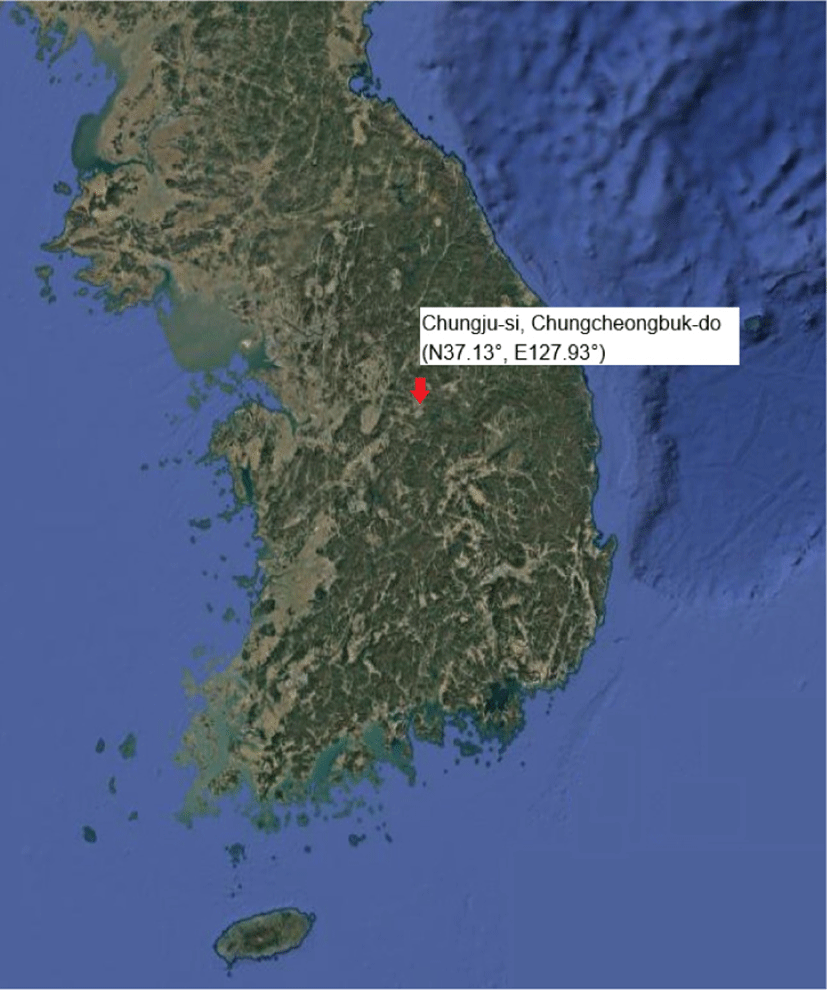
This study employed 40 pieces of Mossy locust grown at Mountain 81, Gachun-ri, Eomjeong-myeon, Chungju-si, Chungcheongbuk-do (N37.13°, E127.93°). The target logs were straight-grained wood with a small-end diameter of more than 300 mm, and the average age was approximately 32 years (Fig. 1).
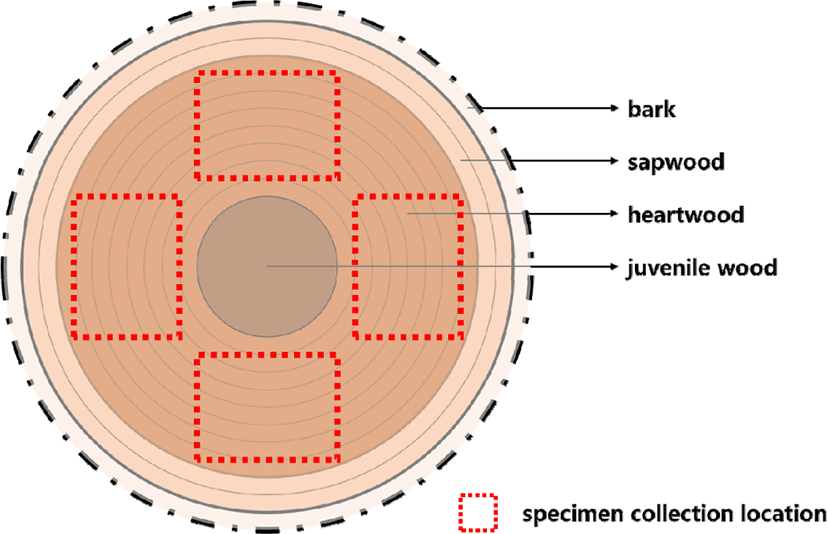
The basic material properties of Mossy locust were analyzed by dividing them into anatomical, physical and mechanical properties, and chemical composition. Anatomical characteristics were evaluated by measuring the length, width, and cell wall thickness of wood fibers and vessel elements. Regarding physical properties, specific gravity and shrinkage rates were measured. As for mechanical properties, bending strength, compression strength parallel to the grain, tensile strength parallel to the grain, shear strength, and hardness were measured. Chemical composition analysis included ash, extractives, lignin, and sugars. Tests for each item were performed according to methods applied in previous studies based on KS and ASTM standards, as shown in Table 1 (Park et al., 2024a). Evaluation methods for anatomical properties were determined based on similar previous studies, due to the absence of standard specifications for the properties (Kim et al., 2024; Lee and Bae, 2021; Lee et al., 2021a, 2021b, 2021c; Nam and Kim, 2021). Specimens for each evaluation item were collected from the heartwood part, excluding pith and juvenile wood, while using sound wood free of knots or splitting checks and splits (Fig. 2).
| Standard | ||
|---|---|---|
| Anatomical properties | Length of cell | - |
| Width of cell | - | |
| Thickness of cell wall | - | |
| Physical properties | Specific gravity | KS F 2198 (KSA, 2016) |
| Shrinkage | KS F 2203 (KSA, 2020a) | |
| Mechanical properties | Bending strength | KS F 2208 (KSA, 2020d) |
| Compression strength | KS F 2206 (KSA, 2020b) | |
| Tensile strength | KS F 2207 (KSA, 2020c) | |
| Shear strength | KS F 2209 (KSA, 2020e) | |
| Hardness | KS F 2212 (KSA, 2020f) | |
| Chemical composition | Ash | KS M ISO 18122 (KSA, 2015) |
| Extractives | ASTM E 1690 (ASTM, 2021) | |
| Lignin | ASTM E 1758-01 (ASTM, 2020) | |
| Sugars |
Adapted from Park et al. (2024b) with CC-BY-NC.
3. RESULTS and DISCUSSION
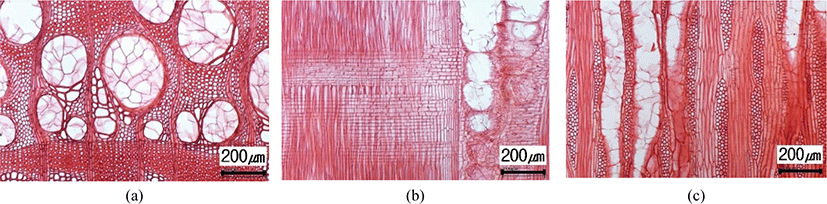
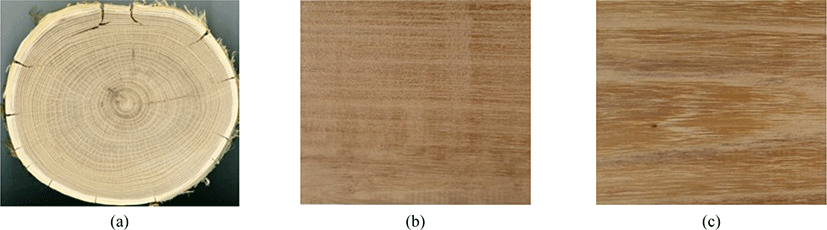
The earlywood fiber length of Mossy locust was 0.86 mm, and the latewood fiber length was 1.13 mm. The width of the earlywood was 18.09 μm in the radial direction and 11.57 μm in the tangential direction; that of the latewood was 10.51 μm in the radial direction and 9.16 μm in the tangential direction. The cell wall thickness of the earlywood was 1.12 μm, and that of the latewood was 2.23 μm. The length of the vessel element of the earlywood was 0.14 mm, and that of the latewood was 0.17 mm. The width of the earlywood was 293.56 μm in the radial direction and 239.79 μm in the tangential direction; that of the latewood was 178.77 μm in the radial direction and 140.72 μm in the tangential direction. The cell wall thickness of the earlywood was 1.64 μm, and that of the latewood was 2.08 μm, indicating a tendency to be slightly thicker in latewood. These outcomes are assumed to reflect the characteristics of Mossy locust cells, which gradually become denser during the growth process. Figs. 3 and 4 present optical microscope images and wood surface images of three sections of Mossy locust.
The specific gravity was 0.614 for green wood, 0.664 for air-dried wood, and 0.713 for oven-dried wood. The total shrinkage was 0.38% in the longitudinal direction, 5.48% in the radial direction, and 8.62% in the tangential direction, along with a total volumetric shrinkage rate of 13.94%. These results indicate that Mossy locust is a tree species with relatively high specific gravity and volumetric shrinkage, compared to typical broad-leaved trees.
The bending strength was 129.0 MPa for air-dried wood and 59.1 MPa for green wood. Compression strength parallel to the grain was 46.0 MPa for air-dried wood and 23.5 MPa for green wood. Tensile strength parallel to the grain was 165.7 MPa for air-dried wood and 98.0 MPa for green wood. Shear strength was 14.2 MPa in the radial section and 15.7 MPa in the tangential section for air-dried wood; it was 9.7 MPa and 10.2 MPa, respectively, for green wood. The hardness of the air-dried wood was confirmed to be 9.3 kN in the cross section, 8.7 kN in the radial section, and 8.6 kN in the tangential section. These results show that Mossy locust is a species with generally high strength characteristics, as it belongs to a high-density hardwood.
The ash content was 0.54%, and the extractive content was 4.98%. The lignin content was 27.81% acid-insoluble and 2.18% acid-soluble, totaling 29.99%. Total sugars comprised 40.73% glucan, 17.09% XMG, and 0.33% arabinan, totaling 58.15%. This chemical composition shows that Mossy locust belongs to the typical range for broad-leaved trees.
4. CONCLUSIONS
This study evaluated the anatomical, physical and mechanical properties, and chemical composition of 32-year-old Mossy locust grown in Chungju, Chungcheongbuk-do, South Korea, in order to establish a database (DB) on wood properties for Korean major domestic wood species (Table 2). Although this study has a limitation in targeting Mossy locust grown in a single region, it provided a benchmark for future comparative and expanded research by comprehensively analyzing and quantitatively illustrating the basic material properties of the domestic Mossy locust. Since the material properties of domestic tree species, including Mossy locust, can vary greatly under different regions and site conditions, it is necessary to continuously evaluate diverse species and origins so as to derive representative values. This study serves as a starting point for such long-term research, and the findings of the study are expected to be utilized as foundational data for establishing domestic wood material property databases for each region, and for efficient utilization.
| Anatomical properties | ||
| Length of fiber (n = 30) | Width of fiber (n = 30) | Thickness of cell wall for fiber (n = 30) |
| Chemical compositions | ||||
| Ash (n = 6) | Extractives (n = 6) | Lignin (n = 6) | ||
| Acid-insoluble | Acid-soluble | Total | ||
|
0.54% (0.10) |
4.98% (0.21) |
27.81% (0.92) |
2.18% (0.46) |
29.99% (1.36) |
| Sugars (n = 6) | |||
| Glucan | XMG** | Arabinan | Total |
|
40.73% (0.54) |
17.09% (0.30) |
0.33% (0.00) |
58.15% (0.84) |

